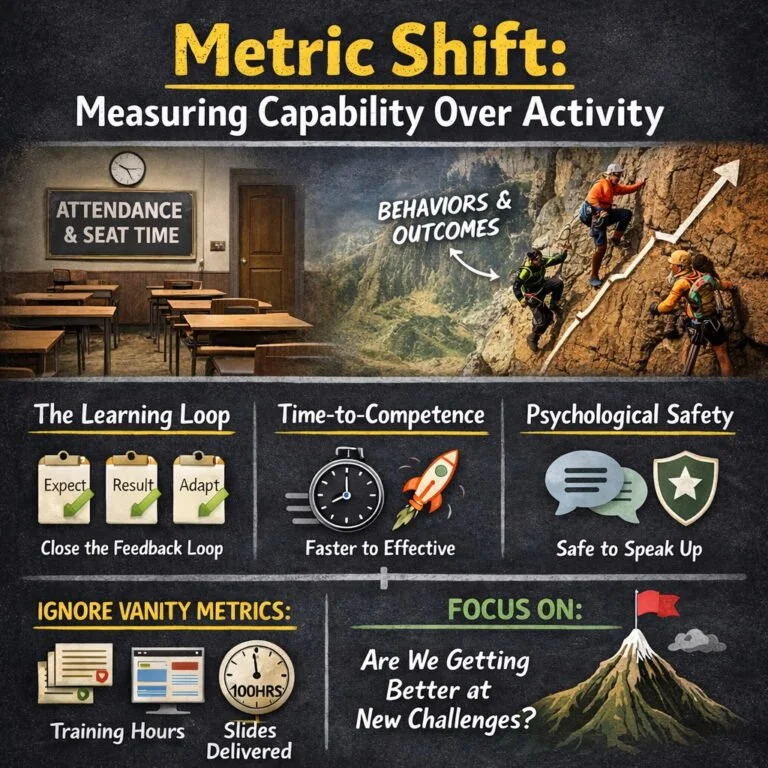
Post 12 – Metric Shift: Measuring Capability over Activity
If you can’t see real growth, you’ll default to what’s easiest to count: attendance and seat time.
But in a fast-moving market, it doesn’t matter how many hours someone spent in a classroom; it matters if they can perform when things get difficult. To build a truly resilient team, you have to stop measuring “presence” and start measuring behaviors and outcomes.
1. Measure the “Learning Loop” (Not Attendance)
Don’t just track whether people started a project or a training module—track whether they completed the feedback loop. Focus on After-Action Reviews (AARs):
What did we expect to happen?
What actually happened?
What are we changing for next time?The Goal: Progress isn’t just “doing things”; it’s closing the loop between action and insight.
2. Measure “Time-to-Competence”
The true test of a team is how they handle unfamiliar work. Watch these indicators:
First-Attempt Quality: How much rework is required on new initiatives?
Speed to Autonomy: How quickly can a new hire or team member become independently effective?
The Iteration Rate: How fast can the team ship a “good enough” version 1.0?The Goal: If your team is actually growing, they should get better at handling the “unknown” over time.
3. Measure Psychological Safety
High performance requires an environment where people can take risks. Use a simple, quarterly pulse check to see if your team agrees with these statements:
“It is safe to ask for help or voice concerns.”
“Mistakes are treated as opportunities to improve, not reasons for blame.”
“We can respectfully challenge decisions.”The Goal: Safety isn’t about “vibes”—it is the baseline requirement for high-speed adaptation.
What to Ignore: The “Vanity Metrics”
Stop rewarding numbers that look good on a spreadsheet but don’t drive the bottom line:
Total training hours completed.
Number of slides delivered.
Content “engagement” scores.These numbers can skyrocket while actual performance stays flat.
The Bottom Line
If you need one simple question to guide your leadership: Are we getting faster at becoming good at new things? In a world of constant change, the ability to learn quickly is your only permanent competitive advantage.
What are you currently measuring that rewards “looking busy” instead of “getting better”?