High Support and High Challenge: The Leadership Combination That Liberates People
POST 5 OF 7
High Support and High Challenge: The Leadership Combination That Liberates People
Support says, “I see you, I believe in you, and I will equip and encourage you.” Challenge says, “I will tell you the truth, hold you accountable, and expect you to do the work.” Liberation holds both.
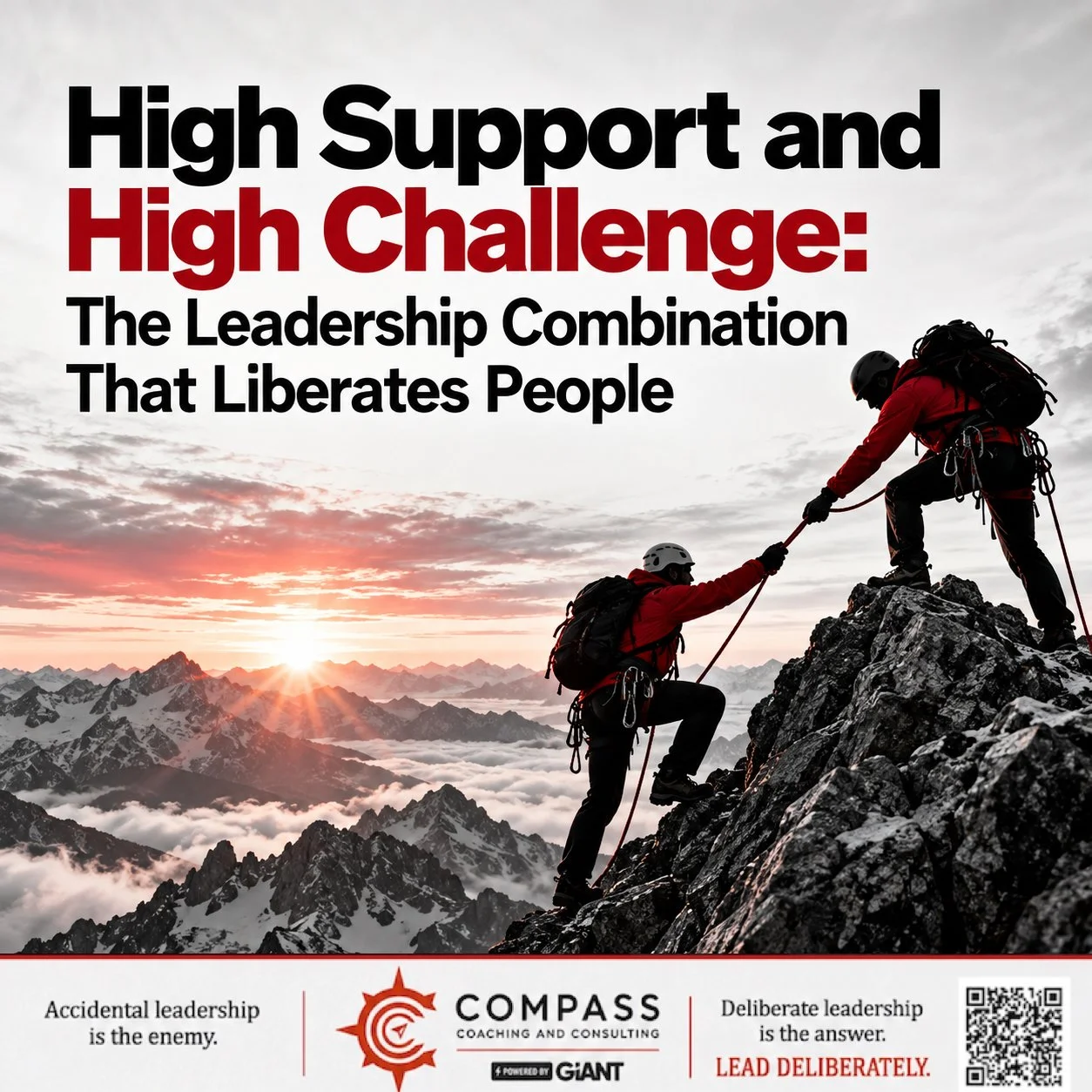
Think about what a climber needs to make meaningful progress.
A climber needs support: the right equipment, preparation, information, encouragement, and a trustworthy partner. A climber also needs challenge: real terrain, increasing responsibility, honest feedback, and standards that cannot simply be negotiated away when the climb becomes difficult.
Remove challenge and no strength develops.
Remove support and a stretch becomes abandonment.
Leadership works the same way.
Support is not rescue. It is not lowering the standard, removing every obstacle, or stepping in whenever someone begins to struggle. Support means creating the conditions that help someone succeed while still allowing them to carry the responsibility that belongs to them.
Some support is practical.
It provides clarity, resources, training, context, access, advocacy, and coaching. It helps people understand what is expected, equips them with what they need, and removes unnecessary barriers that keep them from moving forward.
But support is also deeply relational.
It communicates, I see you. I believe in you. I am with you.
It means listening well, offering encouragement, recognizing effort, creating psychological safety, and giving people room to ask questions, admit uncertainty, or say, “I am stuck,” without feeling diminished.
Sometimes support means reminding someone of what they are capable of when they cannot yet see it for themselves.
A supportive leader asks, Do you have what you need to take the next step?
They are available without hovering, present without controlling, and willing to coach without immediately taking over.
In the climbing metaphor, support is the equipment, the rope, the preparation, the route information, and the trusted person on the other end of the line.
But none of those things climb the mountain for you.
That is where challenge enters.
Challenge says, You are capable, so I will not take away the responsibility that belongs to you.
Challenge brings clear expectations, honest feedback, ownership, accountability, boundaries, and follow-through. It addresses performance gaps instead of avoiding them. It tells the truth when the truth is uncomfortable. It expects commitments to be kept and requires people to wrestle with problems, make decisions, learn from consequences, and do the work necessary to grow.
Healthy challenge is not harshness.
It is respect.
It communicates, I believe enough in your capacity that I will not lower the standard simply to make this easier.
That is why support and challenge must remain connected.
Low support and low challenge is abdication: You are on your own, and I am not paying close attention.
High challenge with low support is domination: Meet the standard or face repercussions, but do not expect much help getting there.
High support with low challenge is over-protection: It’s hard for me to watch you struggle, and I don’t want to risk hurting your feelings by saying what needs to be said. So instead of challenging you to grow, I’ll step in, rescue you, and carry what you need to learn to carry yourself.
But high support and high challenge is liberation: I believe in you. I will equip you. I will encourage you. I will tell you the truth. I will hold you accountable. And I will not lower the standard your growth and our mission require.
That is the environment where people are both valued and developed.
It is also where psychological safety matters most.
Psychological safety is sometimes mistaken for being nice, keeping people comfortable, or avoiding difficult conversations. But healthy psychological safety is not the absence of challenge.
It is the confidence that interpersonal risks—asking questions, admitting mistakes, raising concerns, offering dissent, or acknowledging uncertainty—can happen without humiliation or retaliation.
That kind of safety does not weaken accountability. It makes accountability more productive.
People can say, “I do not know,” early enough to receive help.
They can identify a problem with the route before the team is fully committed to it.
They can receive correction without believing they themselves are the problem.
They can disagree without fearing that disagreement will damage the relationship.
Support creates the relational safety necessary for honesty. Challenge ensures that honesty leads somewhere.
That balance matters because equal treatment is not always equitable development.
A novice climber and an experienced climber may be headed toward the same summit, but they may require different equipment, instruction, preparation, and decision-making authority along the way.
Leadership development works the same way.
The question is not, How do I keep this from becoming difficult for them? The better question is, What combination of support and challenge will allow this person to own the next stretch?
For one person, support may mean greater clarity, additional training, better resources, advocacy, encouragement, or scheduled coaching. For another, the challenge may need to increase through a firm deadline, candid feedback, a difficult assignment, greater decision-making responsibility, or genuine ownership of an outcome.
The goal is not comfort. The goal is growth.
The mountain metaphor helps make the balance clear.
Equipment represents the resources, training, and tools people need to succeed.
The rope team represents relational trust, encouragement, and mutual responsibility.
Steeper terrain represents the meaningful stretch assignments that develop capability.
Turning back can represent a wise boundary, a necessary change in direction, or the recognition that continuing on the same route is no longer the best decision. It is not automatically failure.
And liberation happens when high support and high challenge exist together. Support without challenge can create comfort without growth and, over time, dependence. Challenge without support can create pressure without trust, compliance without development, or accountability without connection.
But when the two are held together, the message becomes different:
I care about you enough to encourage you, and I respect you enough to hold you accountable. I will equip you, but I will not do the work for you. I will stay connected, but I will not remove every difficult stretch. I will tell you the truth, and I will help you grow through it.
Healthy support does not eliminate struggle. It makes productive struggle possible.
A leader who constantly steps in may believe they are helping, but over time they can unintentionally communicate, I do not believe you can do this without me. What begins as support can become dependence.
Liberating leadership sends a different message:
I believe you can do this. I will help you prepare. I will equip you with what you need. I will encourage you when the climb gets difficult. I will stay connected and coach you when necessary. I will tell you the truth and hold you accountable.
But I will not climb your mountain for you.
That is deliberate leadership.
Support creates the conditions for success. Challenge requires people to take responsibility for pursuing it.
And liberation holds both.
As you think about the people you lead, consider a few questions:
Would they experience your leadership as over-protective, dominating, abdicating, or liberating?
What support does one person need from you right now—practical, relational, or both?
What challenge have you been tempted to remove because watching someone struggle feels uncomfortable?
Where do you need to encourage more deeply?
Where do you need to hold someone more clearly accountable?
Your responsibility as a leader is not to climb the mountain for your people. It is to equip them, encourage them, tell them the truth, hold them accountable, and help them develop the confidence and capability to climb.
Next in the series: How to confront a performance gap without attacking a person’s identity.