Three Deliberate Shifts From Performer to Multiplying Leader
POST 4 OF 7
Three Deliberate Shifts From Performer to Multiplying Leader
The goal is not to become unnecessary. It is to stop making your personal contribution the team’s only reliable path to success.
For many leaders, the behaviors that helped them become successful are the same behaviors that eventually limit the growth of the people around them.
They know how to produce results. They solve problems quickly. They step in when something needs to get done. They become the person everyone trusts to have the answer.
Those qualities are valuable.
But at some point, leadership requires a shift.
Instead of simply producing results, multiplying leaders begin building the capacity of others to produce results.
Results still matter. The summit matters. But a multiplying leader asks two questions:
Did we deliver?
And…
Did our capacity grow while we delivered?
A team can hit a number through the heroic effort of one leader and still become weaker in the process.
I’m going to say this again: A team can hit a number through the heroic effort of one leader and still become weaker in the process.
Another team may achieve the same result while more people learn to decide, communicate, coach, solve problems, and own outcomes.
The second team isn't simply producing.
It is multiplying.
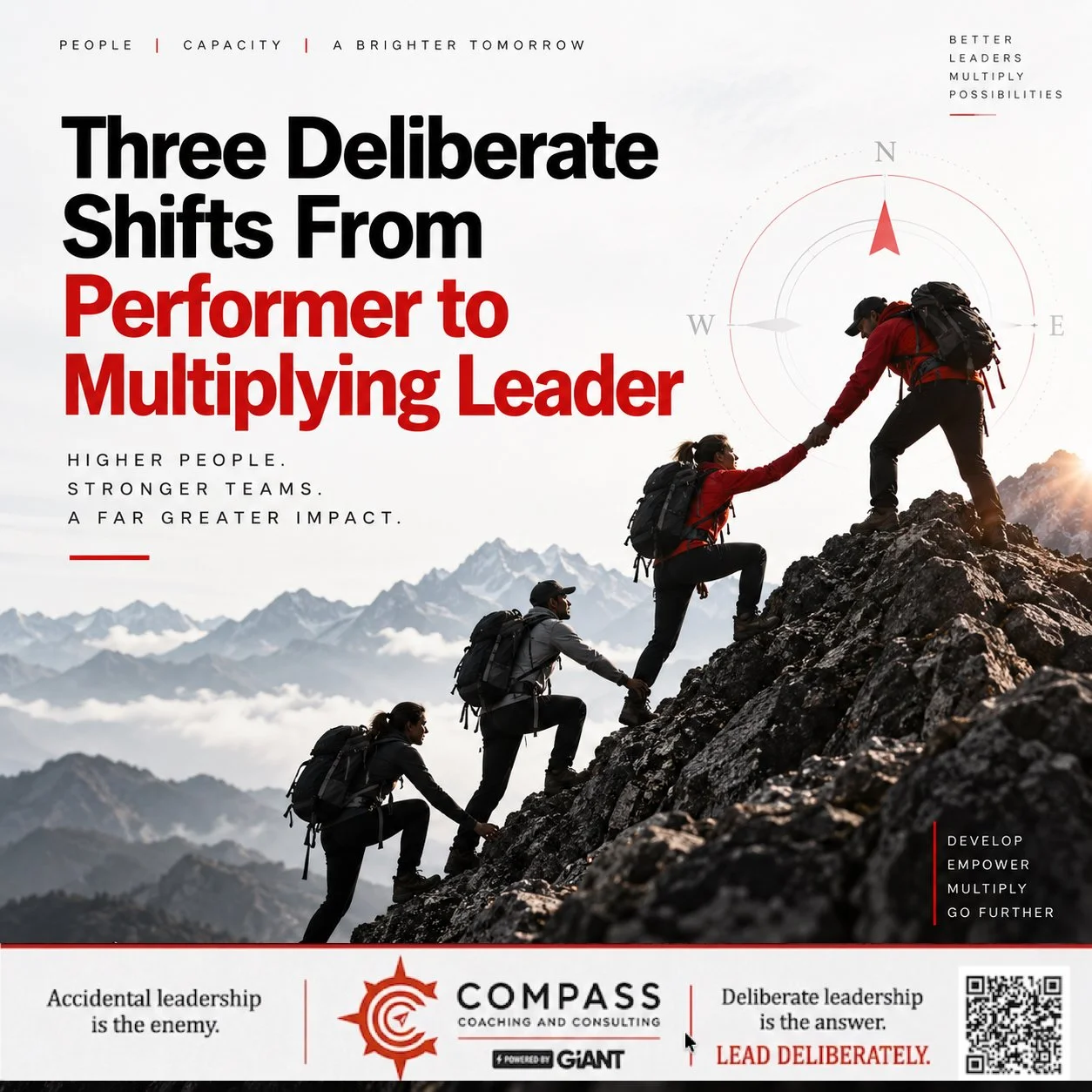
Think about climbing a mountain. Reaching the summit represents producing the required result. But a great guide isn't satisfied with simply getting everyone to the top. Along the way, the guide is teaching people how to climb.
That leads to another important shift.
Strong performers are often rewarded for having fast answers. They see a problem, diagnose it, and solve it.
Multiplying leaders learn to distinguish between a moment that needs an answer and a moment that needs development.
Sometimes urgency requires a direct decision. Leadership does not mean turning every situation into a coaching exercise.
But when every situation is treated as urgent, the leader keeps all the decision-making.
And eventually, everyone learns the same lesson: Wait for the leader.
Deliberate leaders create a different pattern.
They explain how they frame the problem. They ask others for a recommendation. They test assumptions. They allow people to make decisions and experience the consequences of those decisions.
Instead of simply telling climbers where to step, they teach them how to read the mountain.
Conditions change. Weather moves in. The terrain becomes unpredictable. The goal isn't merely compliance with the guide's instructions. The goal is developing the discernment to recognize conditions and make wise decisions.
That's what multiplication looks like.
And perhaps the most difficult shift is moving from being needed to building independence.
Being needed can feel like proof that we matter.
A full inbox, nonstop questions, and decisions waiting for approval can even look like influence.
But dependence is not multiplication.
If every climber must remain permanently attached to the guide, the guide hasn't truly developed climbers.
A guide's success is demonstrated when people can eventually read the conditions, make wise choices, navigate difficult terrain, and help others do the same.
Healthy leaders build people who can lead without constant access to them.
That doesn't make the leader unnecessary.
It makes the leader's impact bigger.
Multiplying leadership creates people who can carry responsibility, make decisions, develop others, and move the mission forward without waiting for the leader to enter every conversation.
That's why a simple weekly audit can be so valuable.
At the end of the week, ask yourself:
What did I produce?
What capacity did I multiply?
Which problem did I solve that I should teach someone else to solve?
Where did I become a bottleneck?
What responsibility can I transfer with appropriate support next week?
You might also ask:
Which of these shifts is hardest for me?
Where am I still the team's only reliable path to success?
What responsibility could I deliberately transfer this month?
Accidental leadership repeats the behaviors that once produced personal success.
Deliberate leadership chooses the behaviors the team now needs.
The summit still matters.
But the greater measure of leadership may be how many people become stronger climbers because you helped them learn the mountain.
Next in the series: Why people grow best when leaders combine high support with high challenge.