Stop Rescuing Your Team: Support the Climber Without Carrying the Climber
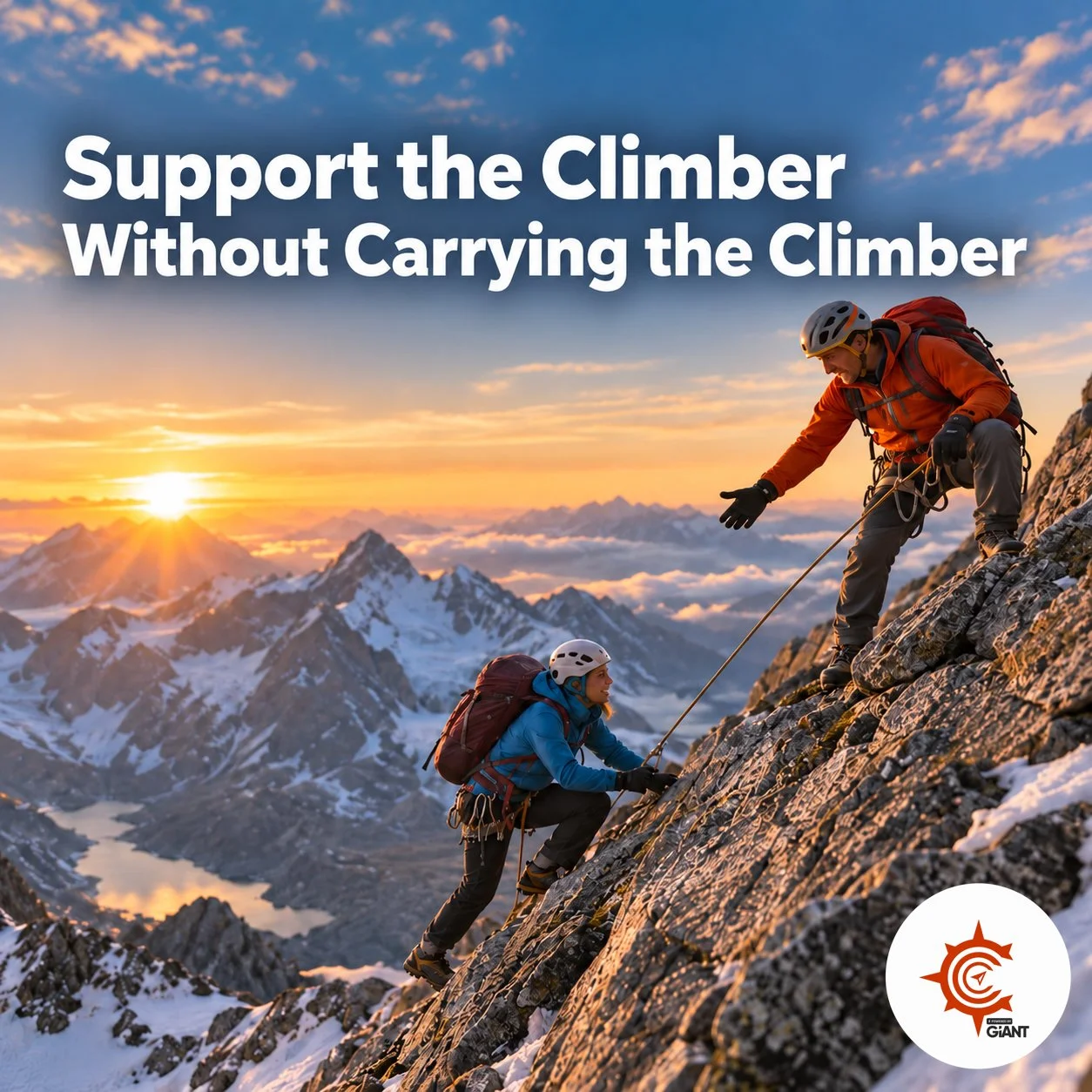
Support the climber without carrying the climber.
Post 3 of 7
Stop Rescuing Your Team: Support the Climber Without Carrying the Climber
Rescuing is efficient today and expensive tomorrow.
A team member brings you a stalled project and asks, “What should I do?” You can see the answer immediately. You could probably fix the problem in twenty minutes. Coaching them through it might take an hour.
So you take it back.
The client is served. The deadline is met. The problem disappears. You feel useful. It looks like leadership.
But something else just happened.
The team member learned that when the climb gets steep, the safest move is to return the problem to the leader.
That is the hidden cost of rescue.
I’m not saying there’s never a time to “rescue”, but rescue should not be reactive. Every time a leader repeatedly steps in and takes difficult work back, it may create short-term productivity while quietly creating long-term dependence. The leader becomes the bottleneck. The team waits for answers. Decisions pile up. Talented people stop exercising discernment because escalation becomes easier—and safer—than ownership.
Eventually, the leader becomes frustrated and says, “Why doesn’t anyone take ownership?”
The uncomfortable answer may be that we have unintentionally trained them not to.
Deliberate leaders recognize that support is not the same as carrying.
Think about a mountain guide. A good guide stays close. They watch the conditions. They provide equipment. They teach technique. They point out danger. They establish safeguards. And when the situation truly requires intervention, they step in.
But a guide cannot develop a climber by carrying that person to the summit.
Leadership works the same way.
Provide context. Clarify the standard. Establish decision boundaries. Make resources available. Agree on check-in points. Then allow the person to do meaningful work.
Support the climber. Do not carry the climber.
One of the most practical ways to do this is to resist answering too quickly.
When someone asks, “What should I do?” your first response does not always need to be an answer.
Try asking:
What are you seeing?
What options have you considered?
What principle should guide this decision?
What do you recommend?
What risk would cause you to escalate?
What will you do next?
Then provide the context they could not reasonably know. Clarify the boundaries. Agree on the next move and establish a time to review what happened.
Yes, that process may take longer today.
But the goal of leadership is not simply to make today easier. It is to build people who are increasingly capable of handling tomorrow.
That does not mean leaders should refuse to intervene.
Non-rescue is not neglect.
A mountain guide steps in when the conditions become genuinely dangerous. Leaders should do the same when safety, ethics, legal exposure, customer harm, significant financial consequences, or irreversible risk demand intervention.
Deliberate leadership is calibrated.
The goal is not to prove that people can struggle alone. The goal is to create the appropriate level of responsibility, support, and consequence for their current level of capability.
The mountain metaphor gives us a helpful way to think about it.
A steep section is a difficult assignment or decision.
Taking the pack is taking the work back from the learner.
A belay or safeguard is a boundary that prevents unacceptable risk.
A check-in camp is a scheduled point to stop, assess progress, and make adjustments.
And carrying the climber is over-functioning to the point that the other person never develops the strength, judgment, or confidence required for the next climb.
That is why deliberate leaders learn to tolerate a little short-term friction.
They understand that constantly being the fastest person to solve the problem may feel productive, but it can prevent everyone else from becoming better problem-solvers.
So consider your own leadership:
Where has your helpfulness quietly become rescue?
What problem keeps finding its way back to you?
And what question could you ask that would return ownership without withdrawing support?
The next time someone encounters a steep section, resist the urge to immediately grab the pack.
Stay close.
Provide the right safeguards.
Ask better questions.
Give them the opportunity to climb.
Because your job is not simply to get people to the summit.
Your job is to help develop people who can climb.
Next in the series: Three deliberate shifts that move a leader from producer to multiplier.