Your Culture Is Telling on Your Leadership
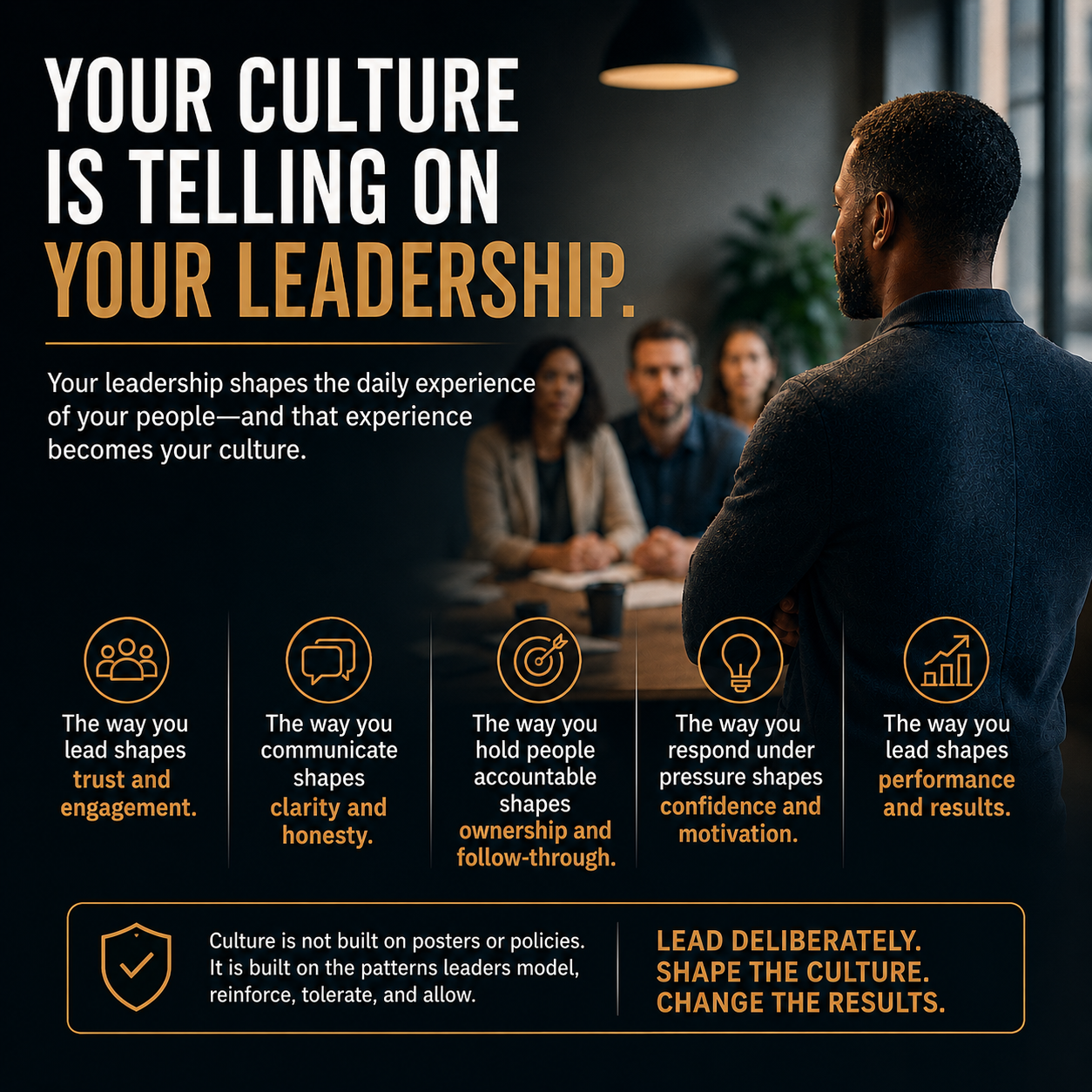
Your Culture Is Telling on Your Leadership (Post #2 in New Series: The Results You’re Getting - What Your Culture Reveals About Your Leadership)
One of the most important questions a leader can ask is not simply, “Am I working hard?” or “Do I care about my people?”
Those questions matter. Most leaders do care. Most leaders are working hard. Most leaders are carrying pressure, responsibility, and expectations that others may never fully see.
But those questions do not tell the whole story.
A more revealing question is this:
What does the culture around me reveal about my leadership?
The culture around a leader often reveals what that leader has consistently modeled, reinforced, tolerated, corrected, or avoided. Every leader is creating, shaping, or allowing a culture. That culture may encourage ownership, honesty, focus, learning, accountability, trust, and healthy performance. Or it may unintentionally reinforce hesitation, confusion, avoidance, over-dependence, silence, or disengagement.
Most leaders do not intentionally create unhealthy cultures. Often, they are doing their best with the habits, pressures, and assumptions they have learned over time. But whether intentional or not, leadership leaves an imprint.
Daniel Goleman’s work on leadership styles connects leadership behavior to organizational climate and performance. His research supports the idea that how leaders communicate, motivate, make decisions, and respond emotionally affects the work environment. Gallup’s workplace research reinforces this as well, showing the significant role managers play in employee engagement. Engagement is not simply an employee trait. It is shaped by the daily experience people have with their leaders.
Organizational psychology points to a similar truth: people learn culture by paying attention to what leaders consistently reinforce.
Culture is one of the clearest mirrors of leadership.
If people regularly wait to be told what to do, the culture may be revealing a pattern of over-functioning leadership.
If people hesitate to speak honestly, the culture may be revealing how truth has been received in the past.
If accountability is weak, the culture may be revealing unclear expectations, inconsistent follow-through, avoided conversations, or tolerated behavior.
If communication is poor, the culture may be revealing what has not been clarified, modeled, or practiced.
This does not mean every issue is the leader’s personal fault. But it does mean the leader is responsible for studying what the culture is revealing and deciding what needs to change. Whatever the leader tolerates, the leader authorizes to exist.
Leadership is the most significant culture-shaping force because leaders decide what is allowed to become normal.
Leadership does not only shape strategy or structure. It shapes the lived experience of the people being led. A leader’s behavior affects whether people feel clear or confused, trusted or controlled, motivated or discouraged, engaged or disconnected, safe or guarded, accountable or uncertain.
Over time, those experiences become the culture. And that culture begins to shape the results.
This is why leadership matters so deeply. The leader’s patterns become part of the team’s atmosphere. People adjust to what leaders model, reinforce, tolerate, and allow.
So the question is worth asking honestly:
What is your team culture currently revealing about your leadership?
At Compass Coaching and Consulting, we help leaders examine the culture around them with honesty and develop the clarity, consistency, and courage to lead more deliberately.