Results Reveal the Culture You Have
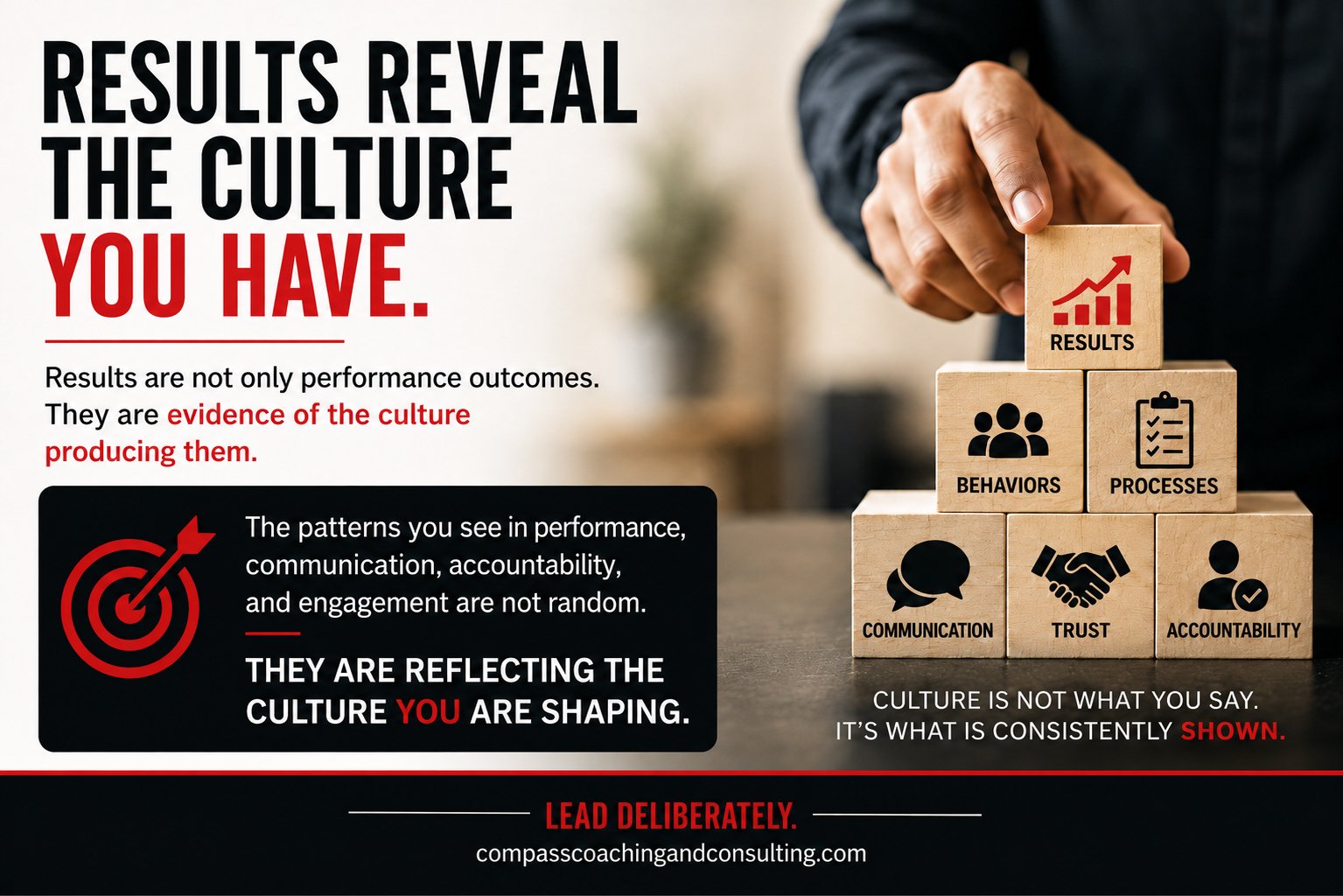
Results reveal the culture you have.
Results Reveal the Culture You Have (Post #3 in New Series: The Results You’re Getting - What Your Culture Reveals About Your Leadership)
When results are disappointing, it is natural for leaders to focus first on the visible symptoms.
The team is not communicating well.
People are not taking ownership.
Performance is inconsistent.
Meetings are not productive.
Accountability feels weak.
The organization feels reactive.
Those observations may be accurate. But they are incomplete unless the leader is willing to ask a deeper question:
What does this result reveal about our culture?
And then an even more personal one:
What does this culture reveal about my leadership?
Results are not only performance outcomes. They are evidence of the culture producing them.
McKinsey’s research on leadership effectiveness identified several behaviors that strongly distinguish effective leaders, including problem-solving, results orientation, seeking different perspectives, and supporting others. That research aligns with what organizational psychology often points us toward: culture is not only what an organization says it values. Culture is revealed in repeated behavior.
Results are often the visible expression of invisible norms.
If people avoid hard conversations, there may be a culture where honesty has not felt safe or productive.
If people do not take initiative, there may be a culture where decision-making is too centralized.
If people are unclear, there may be a culture of shifting priorities or vague expectations.
If poor performance lingers, there may be a culture where difficult conversations are delayed or avoided.
If people are burned out, there may be a culture where urgency has replaced focus.
None of these patterns should be used as a reason for shame. Shame rarely helps leaders grow. But these patterns should be used as information.
Leaders who grow are willing to study the results in front of them. They look beyond the surface and ask what those results may be revealing about the culture. Then they go one layer deeper and ask what the culture may be revealing about their leadership.
That takes humility. It also takes courage.
Because sometimes the issue is not only what the leader says. It is what the leader permits.
A leader may say accountability matters, but if missed expectations are repeatedly allowed to continue, the culture learns something.
A leader may say honesty matters, but if people are punished, dismissed, or ignored when they speak truthfully, the culture learns something.
A leader may say ownership matters, but if decisions are always taken back by the leader, the culture learns something.
A leader may say focus matters, but if everything is treated as urgent, the culture learns something.
Culture is shaped by what is modeled, reinforced, corrected, tolerated, and allowed. That means leaders have to ask a difficult but necessary question:
Who or what am I allowing to shape the culture in a direction I do not actually want?
That question is not about blame. It is about ownership.
Better leadership begins when leaders are willing to see results not only as outcomes to manage, but as feedback about the culture they are responsible to shape.
So before you move too quickly to fix the symptom, study the pattern.
What repeated result on your team may be revealing something important about your culture?
And what might that culture be revealing about your leadership?